Concrete frame of a commercial building under construction below a tower crane and a grey sky

Commercial construction insurance

Commercial construction insurance carries the higher liability limits, umbrella layers and wrap-up requirements that commercial and institutional projects demand. Owner-controlled programs, bonding and certificate compliance are usually contractual conditions, so on this work the owner's contract has written much of your insurance before you price the job.

Talk to an expert

Get a quote

Your own program

What commercial construction insurance covers

Commercial contractor insurance is the program you keep whether or not an owner wraps the job. Four lines stay yours on every project. Three more are bought by whoever the owner's contract names, and on commercial work that is often the owner.

01Yours on every job

Commercial general liability. Written to the owner's exhibit.

Third-party injury and property damage from your operations and completed work. Commercial owners commonly ask for the general aggregate to apply per project, by endorsement, so a claim on one job cannot use up the limit standing behind another.
02Yours on every job

Workers compensation and employers liability.

Your own policy still answers for the office, the yard, off-site shops and every project nobody has wrapped. Where a wrap enrolls your site payroll, that payroll is reported to the wrap and kept out of your own audit, so the two have to be split cleanly.

03Yours on every job

Commercial auto. Rarely inside the wrap.

Wrap-ups almost always exclude automobile liability, so pickups, crew trucks and the vehicles delivering to site stay on your own policy on every job, enrolled or not.

04Yours on every job

Umbrella and excess. The total the owner names.

The owner's exhibit sets the total, and it tends to rise with the project's value and the owner's own appetite for risk. Your tower has to reach that figure across liability, auto and employers liability.

05Named by the contract

Builders risk.

On commercial work the owner often buys it, sometimes alongside the wrap. Check that the policy names you and your subs, and that it waives subrogation among the parties on the job, or a fire your crew starts can come back to you as a claim.

06Named by the contract

Contractors pollution liability.

Hospitals, labs and older campuses carry asbestos, lead and mold behind the walls you open. Many institutional exhibits now name pollution cover, and some wraps include it while many do not.

07Named by the contract

Owners and contractors protective.

A separate policy bought by you and issued in the owner's name, covering the owner for its own liability arising from your work. Some public owners ask for it in place of, or as well as, additional insured status.

On the largest owners' exhibits the total liability limit is set well above any primary policy, so the program needs an umbrella sized to the exhibit before the bid goes in, not after award. How the other roles on a site divide the same lines is laid out in the construction insurance guide.

Project type

Four kinds of owner, four different exhibits

On commercial work the owner's sector shapes the contract more than your trade does. Choose the nearest and the ledger shows what that owner's exhibit tends to set, where claims start, and what stays on your own program.

Hospitals, labs, universities and senior living

Often built or extended beside a building that never closes. These owners are sophisticated buyers of insurance with their own risk managers, and many large capital projects arrive with a wrap-up already designed.

What the underwriter asksWhether the project sits in an OCIP, the infection control requirements, work next to occupied space, and the completed operations term
Where the claim startsDust or water reaching a working patient area, a utility shutdown that stops a department, a design-assist detail that fails after occupancy
What stays on your programYour own program for off-site prefabrication and the yard, pollution cover for disturbed materials, professional liability for design-assist
Watch forA breach of the dust barrier can arrive as a bodily injury claim from patients. Find out in advance whether the wrap or your pollution policy answers first.Talk to a broker about this

Mixed-use towers, hospitality, data centers and laboratories are read the same way: who the owner is, whether a wrap is in place, and what the exhibit requires. Most mid-market commercial contractors work across two or three of these at once, and the program is rated on the mix.

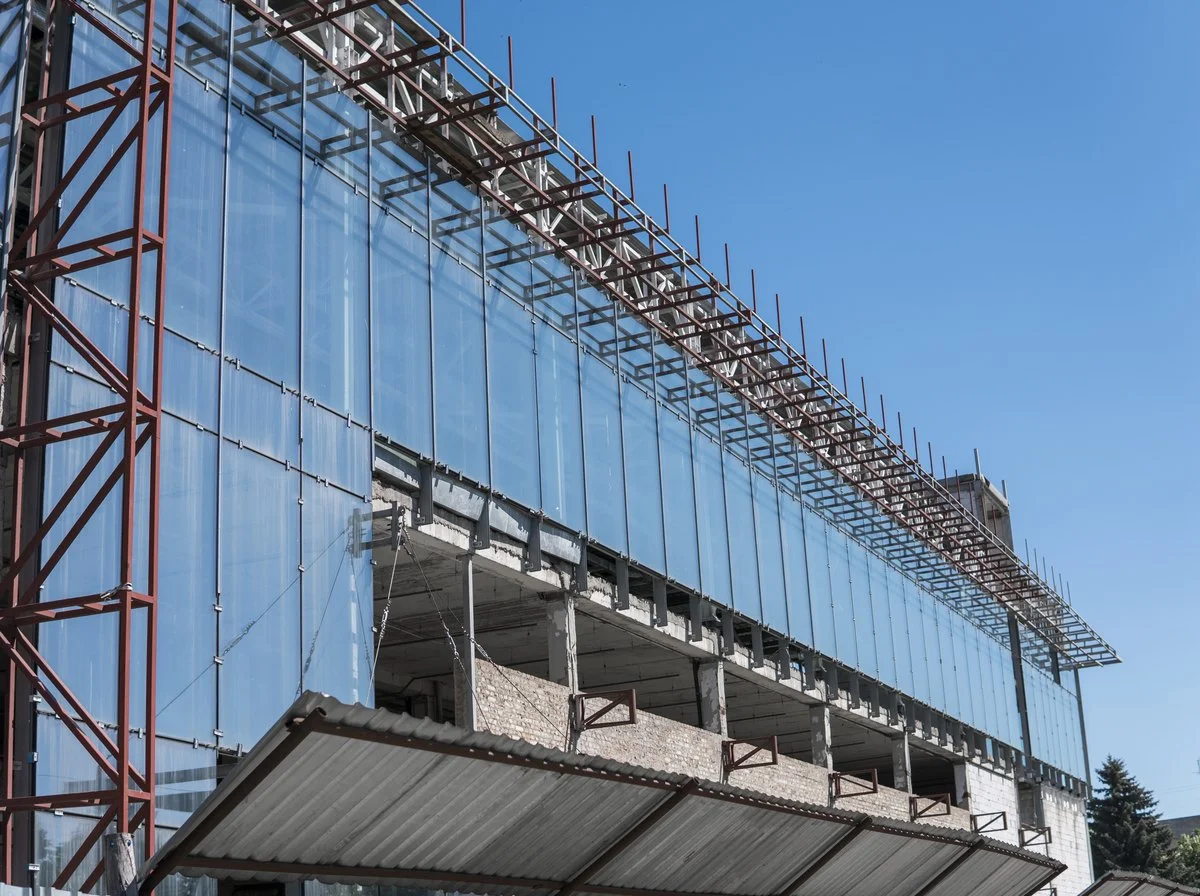
Curtain wall glazing being installed on a commercial building still under construction

Which program answers a loss on a wrapped project

On an owner-controlled project the first question after a loss is not whether anyone is insured. It is which program answers: the owner's wrap, your own, or neither. Three facts usually decide it: whether you were enrolled, where the work happened, and when the damage appeared.

Four losses on wrapped commercial jobs, and where each one tends to land:

The wrap answers: An enrolled carpenter is hurt on the site during the work. Subject to the program's terms, the wrap's workers compensation responds for enrolled payroll on that site.

Not the wrap: A fitter is hurt in your off-site shop while building assemblies for the same project. Enrollment generally stops at the site boundary, so your own comp policy answers.

The wrap answers: A visitor walking a public route past the site is struck by falling debris. Third-party injury from enrolled operations, generally defended under the wrap's liability cover.

Not the wrap: Water through a curtain wall joint you installed appears after the wrap's completed operations term has run out. Your own liability program is next in line, but a wrap-up exclusion on it can leave the claim uninsured.

The fourth line is the one contractors find late, because the exclusion sits on their own policy rather than on the wrap. A wrap's limits are also shared by every enrolled contractor, so one large loss can use up much of the limit for everyone, which is a reason to keep liability cover of your own in force and read its wrap-up wording before you enroll.

The gaps

What commercial construction insurance does not cover

Eight things a wrap-up and a standard contractor program leave out on commercial work. Most of them are why you keep a full program of your own while enrolled.

Off-site fabrication and storage

WHAT YOU NEED

Your own comp and liability, plus an installation floater for assemblies built or stored away from site. Enrollment usually ends at the site boundary.

Your fleet on the way to site

WHAT YOU NEED

Commercial auto in your own name. Wrap-ups almost never include automobile liability.

Defects after the wrap's term ends

WHAT YOU NEED

Completed operations on your own policy, with any wrap-up exclusion read for whether it lifts once the owner's program runs out.

The owner's existing building

WHAT YOU NEED

A contract that says who insures it. Liability forms exclude the part you are working on and property in your care, and builders risk on the new work usually does not reach the old.

Asbestos, lead and mold you disturb

WHAT YOU NEED

Contractors pollution liability, unless the wrap expressly includes it. Contractor liability wordings commonly exclude all three.

Design-build and design-assist errors

WHAT YOU NEED

Contractors professional liability. Owner programs rarely extend to design, and a liability form does not answer for advice.

Your own failure to finish the job

WHAT YOU NEED

A performance bond, which is credit rather than cover. The surety steps in and then looks to you for repayment.

Your plant, tools and rented cranes

WHAT YOU NEED

Contractor's equipment on inland marine. Owner programs insure the project, not the machinery that builds it.

The third card is the one to check on your current schedule today. If a wrap enrolls your on-site payroll, also look at how comp is audited on the payroll left behind, because enrolled and unenrolled hours have to be kept apart all year.

The owner's program

On a commercial job, the owner writes the insurance

A commercial contractor does not design its own insurance from a blank page. By the time the bid set arrives the owner has decided who buys the liability and comp on site, how much bonded work it expects you to carry, and what limits and names your policies must show. Three documents do the writing.

Open lever-arch binder holding a thick stack of project documents

The wrap manual decides what you stop buying

Under an OCIP the owner buys liability, workers comp and usually excess for every enrolled contractor on the site; under a CCIP the general contractor does. You bid net of your own cost for those lines, and the administrator tracks enrolled payroll. Everything not enrolled stays with you: autos, equipment, off-site work, and completed operations once the wrap's term ends, though a wrap-up exclusion on your own policy can leave some of them uninsured.

Printed financial statements under a calculator, a keyboard and reading glasses

Bonding capacity is read off your balance sheet

A surety underwrites a contractor the way a lender would. It reads CPA-prepared financial statements, working capital, net worth and the work-in-progress schedule, then sets a single-project limit and an aggregate across all bonded work. A large award can absorb the line you were counting on for the next bid, so capacity is a planning question before it is a paperwork one.

Payments and draws clause of a printed construction contract with a pen resting on it

The exhibit sets the limit, the term and the names

The owner's insurance exhibit names the per-occurrence and aggregate limits, a per-project aggregate, the total excess, how many years completed operations must stay in force after handover, and every party to be added as additional insured. You build the program to the exhibit. If it is read only at award, the cost of meeting it is already missing from the price.

So the insurance section of the bid documents is best read before the estimate is finished, and the program matched to it line by line. Proving it to the owner afterwards is a separate step, and what a certificate can and cannot show decides whether the exhibit is accepted.

Speak to our team

Bid check

Tick what your bid documents ask for

Each line here comes out of an owner's instructions to bidders or its insurance exhibit. Tick the ones in your current pursuit and the side panel lists what has to sit behind the bid. It is a reading aid, and it prices nothing.

What the bid needs behind it

Pick the lines your current bid set contains and the program items they call for appear here.

Send the insurance exhibit and the instructions to bidders from your next large pursuit. The requirements are usually all there before award, and they are best met before the price is in.

Speak to our team

Cost

How much does commercial construction insurance cost?

Commercial construction insurance cost is set less by your trade than by your projects: their value, how many are wrapped, and what each owner's exhibit demands. Any figure offered before those are known is a guess. Six inputs move a commercial contractor's program most.

01

Construction volume and project values

Revenue and contract values are the base most contractor liability rating starts from, and a single large project draws closer reading of its contract.

Effect on premium
02

How much of the year is wrapped

Enrolled payroll and receipts generally come out of your own rating base, so a year heavy in wrapped projects reads very differently from a year without them.

Effect on premium
03

Limits and terms the exhibits require

The total excess your largest owners name, per-project aggregates, and how many years completed operations must stay in force. Each is priced.

Effect on premium
04

Self-performed payroll by class

Concrete, steel and carpentry crews sit in heavier comp classes than supervision, and only the payroll outside the wraps counts on your own policy.

Effect on premium
05

Loss history and experience modifier

Loss runs and the mod that follows from them. Many institutional and public owners prequalify bidders on the mod, so it affects who you can bid for as well as the price.

Effect on premium
06

Financial statements and backlog

The surety's side of the program. Bond terms and capacity follow your statements, your work in progress and the size of the jobs you take on.

Effect on premium

Three marks flag an input that moves a commercial contractor's program further than the others listed. The marks only compare inputs with each other; they are neither a rate nor a quote.

Where the price is really set

Much of a commercial contractor's insurance cost is fixed by documents somebody else wrote: the owner's exhibit, the wrap manual and the bond form. Read early, they can be priced accurately and carried into the bid. We work from your backlog and the exhibits on your desk, and come back with numbers against that file.

Talk to an expert

Process

How a placement works

We understand your business first, then take it to the carriers who want to write it. An advisor walks you through the options and what they cost. No two files are the same, so what follows is the shape of a placement rather than a script.

  1. Loss runs and a payroll schedule spread on a desk beside a calculator and laptop

    We understand the business first

    What you do, where, with how many people, and what your contracts oblige you to carry. Those answers decide which markets will look at the file at all, and how much of the rest of this applies to you.

  2. Brokerage desk with a monitor in morning light

    We match it to the carriers who want to write it

    One set of information goes to underwriters with genuine appetite for your work rather than whoever happened to quote last renewal. An advisor talks you through what comes back and what it costs.

  3. Stamped certificate on a clipboard with a pen and a magnifier

    After bind, certificate requests read against your contract

    An owner wants proof before your crew can start, and this is how COIs get issued here. We read the certificate request against your contract, so the endorsements the contract needs are requested on the policy and the certificate reports what the policy provides, rather than a generic endorsement that may fail the review.

The program a contractor building commercial and institutional projects carries: general liability, workers compensation, commercial auto and an umbrella of its own, with builders risk, pollution and professional liability added as contracts require. On larger projects much of it is shaped by the owner, through a wrap-up, bonding requirements and an insurance exhibit.

Both are wrap-ups: one program covering the enrolled contractors on a single project or a group of projects. Under an owner-controlled insurance program the owner buys and controls it. Under a contractor-controlled insurance program the general contractor does. The practical questions for you are the same: what is enrolled, and what is not.

Yes. Enrollment covers your on-site work on that project for the lines the wrap includes. Your autos, your equipment, your off-site work, your other projects and your completed operations after the wrap's term all stay on your own program, and a wrap-up exclusion on it can leave some of them uninsured.

The policies share their names. The difference is the contract. Commercial general contractor insurance has to meet owner exhibits with higher limits, per-project aggregates and long completed operations terms, work alongside wrap-ups, and sit next to a bonding program that a smaller residential or service contractor may never need.

By a surety, reading your financial statements, working capital, net worth, work in progress and track record. It sets a single-project limit and an aggregate limit for all bonded work. Better statements and steady profitable completions are what move capacity up over time.

Commonly $1M per occurrence and $2M aggregate on general liability as a floor, often with the aggregate applying per project, and an umbrella or excess layer above that sized to the project. The insurance exhibit sets the number, the completed operations term and the additional insured parties.

An endorsement that removes cover from your own liability policy for projects insured under a wrap-up. Common versions, including ISO's CG 21 54, keep excluding the project after the wrap's completed operations term ends, which can leave a late defect claim with no policy behind it. Read the wording before you enroll.

It depends on your volume and project values, how much of the year is wrapped, the limits and terms your owners require, your self-performed payroll, your loss history and modifier, and for bonds, your financial statements. Carriers quote against your real file rather than a starting figure.

Next bid

Price the next bid with the insurance already settled.

Tell us the owners you build for, the projects open now and the bonds behind them. We will go to market for your own program and read it with you against the wraps and exhibits you work under.

  • Owner exhibits and wrap manuals read with you
  • Direct and wholesale carrier access
  • Standard and E&S markets for construction

This page is general information, not a coverage determination. What your policy covers is governed by its own terms, conditions, and exclusions.

Concrete and glass buildings of a completed hospital campus